
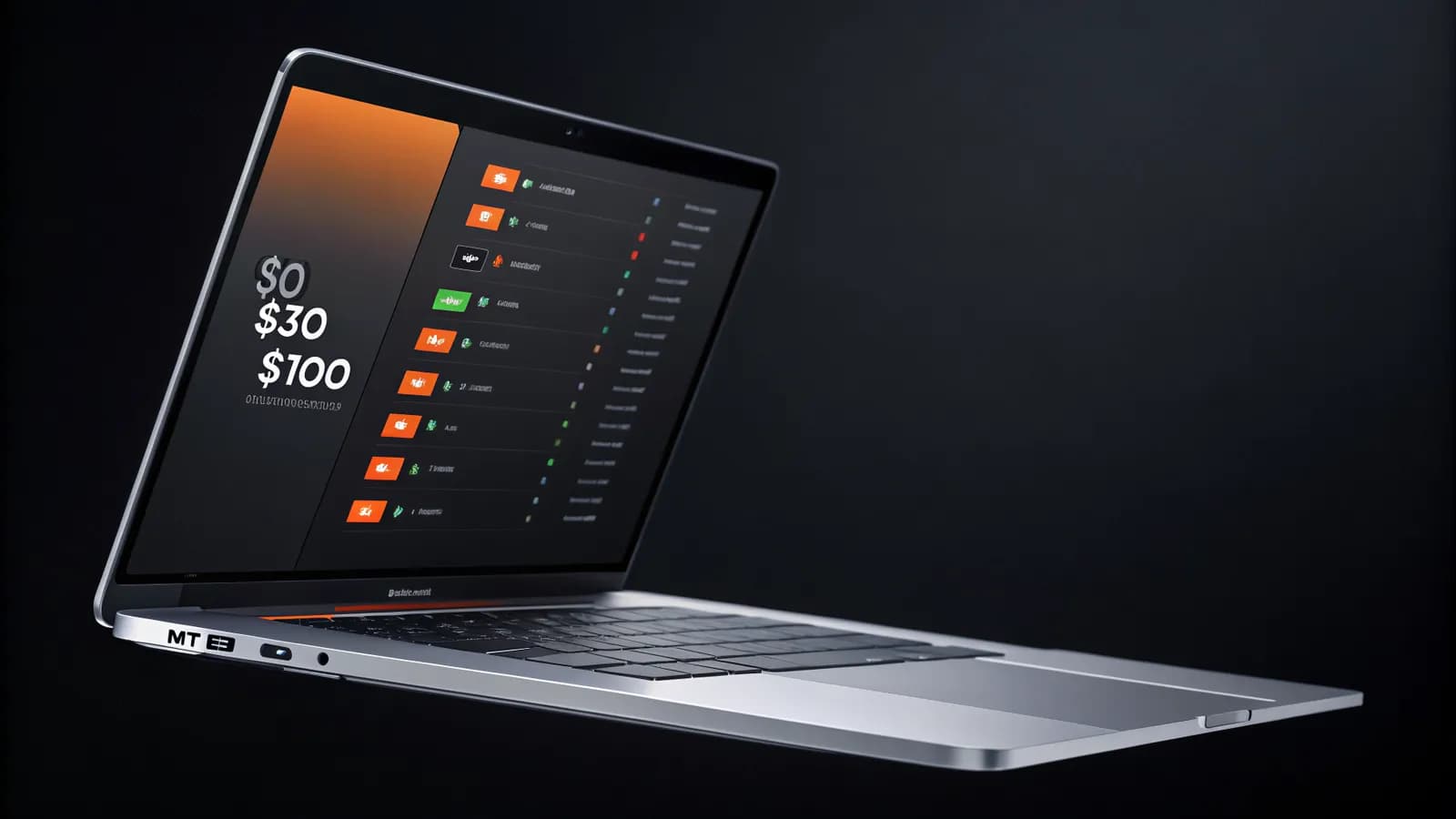
There are two price lists for Grok in circulation, and only one is current. Four of the six explainers ranking above this page still call $300 the top tier, while the vendor sells a $100 plan none of them name. Which list is yours?
The plan page you land on from this query is not the page that closes the invoice. Grok pricing is sold twice: as a consumer subscription that looks like ChatGPT Plus, and as a metered API that looks like a cloud bill. Your team probably pays one of them today and is quietly deciding whether it needs the other. Miss that decision and you either pay for headroom you never consume, or you build on metered tokens whose rate card changes under a rule nobody emailed you about. X Search repriced on 2026-09-21, and one lookup can now bill per post fetched instead of per call.
Grok pricing: the consumer tiers, side by side
Every figure below was read off https://x.ai/pricing on 2026-09-22, in USD.
Plan | Monthly price | Annual price | What the vendor says it includes | Source |
|---|---|---|---|---|
Free | $0/month | Not published | Real-time web and X search, voice mode, connectors, SOC 2 Type I and II. Limits described as "generous", with no number printed | |
SuperGrok Lite | Not published | Not published | A named column in the vendor's compare table with a "Get Lite" action. No price rendered | |
SuperGrok | $30/month | Not published | Higher rate limits, access to frontier models, Grok Bot, connectors, image and video generation, SOC 2 | |
SuperGrok Plus | $100/month | Not published | Everything in SuperGrok, plus 1080p video, significantly higher usage across Chat, Imagine, Voice and Build, lightning-fast replies, priority access at peak times, early access to features | |
SuperGrok Heavy | Not published | Not published | A named column in the same compare table with a "Get Heavy" action. No price rendered | |
Business | Not published | Not published | A named column ("Get Business"). The team block lists seat management, consolidated billing, role-based access control, domain verification, user analytics | |
Enterprise | Contact sales | Not offered | Custom rate limits, a named account team, SSO and SCIM, data residency, volume pricing | |
Read that ladder the way a buyer experiences it: three prices you can act on today ($0, $30, $100), three tiers named and unpriced, and one sales conversation. Lite, Heavy and Business sit in the vendor's compare table with their own action buttons, and the prices are simply not in the page.
Which tier does a marketing team's daily use require? For chat, briefs, campaign copy and image generation, SuperGrok at $30/month is the tier the vendor prices against that workload, and the compare table's Models row places grok-4.6 inside that same block. Plus at $100/month is priced against volume: 1080p video, significantly higher usage across the creative surfaces, priority access when the service is busy. If nobody on your team makes 1080p video or queues behind peak-time limits, $100 buys headroom you will not consume.
One sourcing note, re-checked today. The vendor holds both of the top slots: https://x.ai/pricing sits at position 2 and grok.com/plans at position 3 on 2026-09-22, above every independent explainer. grok.com/plans is client-rendered behind a consent overlay and did not populate across three attempts at read time, so no number on this page comes from that URL. Every tier price came from https://x.ai/pricing, the vendor's plan-comparison surface. The vendor's docs and footer also now read SpaceXAI (verified 2026-09-22) while the field still writes "xAI", and a page that missed the rename has probably missed the ladder too.
Grok API pricing: what a million tokens actually costs
The API half of Grok's pricing lives on a different page from the subscription half, which is why so many teams know one and not the other. Everything below is from https://docs.x.ai/developers/pricing, verified 2026-09-22, and the page dates itself September 7, 2026: the closest thing to a version stamp the vendor provides. Prices are USD per 1 million tokens, and "short context" means a prompt under 200,000 tokens.
Model name as printed on the vendor page | Context window | Input (short) | Cached input (short) | Output (short) |
|---|---|---|---|---|
| 500k | $2.00 | $0.50 | $6.00 |
| 500k | $2.00 | $0.30 | $6.00 |
| 1M | $1.25 | $0.20 | $2.50 |
| 1M | $1.25 | $0.20 | $2.50 |
| 1M | $1.25 | $0.20 | $2.50 |
| 1M | $1.25 | $0.20 | $2.50 |
| 256k | $1.00 | $0.20 | $2.00 |
All rows: https://docs.x.ai/developers/pricing (verified 2026-09-22). The model names are the row labels the vendor's page prints, listed as rate-card SKUs rather than as a claim about which generation leads a product line.
A second, higher set of rates applies once a prompt reaches the long-context threshold:
Model | Input (long) | Cached input (long) | Output (long) | Threshold |
|---|---|---|---|---|
| $4.00 | $1.00 | $12.00 | 200k tokens |
| $4.00 | $0.60 | $12.00 | 200k tokens |
| $2.50 | $0.40 | $5.00 | 200k tokens |
| $2.00 | $0.40 | $4.00 | 200k tokens |
Source: https://docs.x.ai/developers/pricing (verified 2026-09-22).
The mechanic underneath that table is the single most expensive detail on this page. The vendor's wording is that models with long context pricing "bill the long context rates for all tokens in a request once its prompt reaches the model's long context threshold". Not the extra tokens. All of them. A prompt that drifts past 200,000 tokens doubles the rate on every token in the call, including the 190,000 that were already cheap.
On top of the base rates sit four multipliers and discounts, and they do not apply evenly:
- Prompt caching is a discount, published as the cached input column, applied before any multiplier.
- Batch API is 20% off, covering
grok-4.3and thegrok-4.20family only. The vendor is explicit: "Models not listed above have no batch discount." The two most expensive rows get nothing. - Priority Processing is 2x standard rates on every token type, on the Chat Completions and Responses endpoints only.
- The US regional endpoint (
https://us.api.x.ai/v1) is 1.1x global rates, and at read time it coversgrok-4.6only.
Tool invocations are the second cost surface most rate cards forget. Web Search, X Search and Code Execution bill at $5 per 1,000 calls, File Attachments at $10 per 1,000, Collections Search at $2.50 per 1,000, and storage at $0.025 per GiB per day for files and $0.10 for collections. X Search changed on 2026-09-21 at 12:00 PM PT from $5 per 1,000 calls to $5 per 1,000 posts fetched plus $10 per 1,000 user profiles fetched (verified 2026-09-22). If your workflow researches X threads, that one change can move your bill more than any routing decision you make this quarter, and no explainer in the top 14 mentions it.
Worked example: what a marketing team's month costs
Take a realistic content operation: 2 million input tokens and 400,000 output tokens per month. That covers SEO briefs, article drafts, campaign copy variants and a stack of rewrites, and every request stays under the long-context threshold.

Model row | Input cost (2M x rate) | Output cost (400K x rate) | Monthly total |
|---|---|---|---|
| 2 x $2.00 = $4.00 | 0.4 x $6.00 = $2.40 | $6.40 |
| 2 x $2.00 = $4.00 | 0.4 x $6.00 = $2.40 | $6.40 |
| 2 x $1.25 = $2.50 | 0.4 x $2.50 = $1.00 | $3.50 |
| 2 x $1.00 = $2.00 | 0.4 x $2.00 = $0.80 | $2.80 |
All rates https://docs.x.ai/developers/pricing (verified 2026-09-22), short context.
Let one workflow cross the long-context line and the same month looks different:
Model row | Short context | Long context | Multiple |
|---|---|---|---|
| $6.40 | $12.80 | 2.0x |
| $3.50 | $7.00 | 2.0x |
Source: https://docs.x.ai/developers/pricing (verified 2026-09-22).
That 2.0x is not a surcharge on the tokens you added. It is a doubling of the bill for a workload that grew by a fraction, and in practice it is what happens when someone pastes a full content inventory into a prompt instead of querying it.
Now the comparison that decides the purchase. A SuperGrok seat is $30/month (https://x.ai/pricing, verified 2026-09-22) and is not metered per token, so this workload costs nothing extra on it until a rate limit binds. The metered path costs $6.40/month on grok-4.6 at short context with no caching.
Path | Cost for this workload | What else it buys |
|---|---|---|
SuperGrok seat | $30/month | Chat surface, access to frontier models, Grok Bot, connectors, image and video generation, SOC 2 |
| $6.40/month | Metered, no seat, no chat surface. You build the workflow |
| $4.60/month | As above |
| $2.80/month | As above, on a cheaper rate row |
Seat price https://x.ai/pricing, API rates https://docs.x.ai/developers/pricing (both verified 2026-09-22).
The crossover, with its assumption attached: at a 5:1 input-to-output mix, a $30 seat absorbs roughly 4.7x this workload before the API wins on price, which is about 9.4 million input and 1.9 million output tokens per month. Against grok-4.3 the same seat absorbs roughly 8.6x. Flip the mix to 1:1 and the crossover arrives far earlier, because output tokens cost three to six times what input tokens do. Anyone quoting a single break-even number without the token mix is guessing.
So which path does a marketing team need? It depends on whether the work is conversation or plumbing. If your team talks to Grok, the $30 seat wins from day one and it is the only path that includes a chat surface. If your team feeds Grok into a pipeline, the API is cheaper until the pipeline gets big. It is the same decision teams face on Claude Code pricing for marketing teams.
Where the published rates disagree
This is the section the AI Overview at position 1 cannot write, because answering it means checking the vendor's page instead of summarising the pages that already rank. Every explainer below was live on 2026-09-22.
What published sources state | What the vendor page states (verified 2026-09-22) | Who wins |
|---|---|---|
SuperGrok Heavy at $300/month is the top tier: metronome (pos 5, Jan 8, 2026), cloudzero (pos 6, Aug 27, 2026), fritz.ai (pos 7, Jan 26, 2026), tech.co (Jul 14, 2026), sentisight (Jul 28, 2026) | SuperGrok Plus is a priced tier at $100/month. Heavy sits in the compare table with no rendered price | Vendor. Plus is absent from all five, including the freshest independent page in the field |
SuperGrok Lite is $10/month: sentisight, tech.co, geotoolbox (pos 17) | Lite is a named column; no price rendered | Neither. The price is genuinely missing, so it stays a labelled third-party figure or it stays out |
SuperGrok annual is $300/year: metronome and others | No annual price rendered | Vendor, which means do not quote one. Monthly only. Circulating annual figures, including Plus at roughly $1,000/year, are third-party |
The top API tier is $2.00 in / $6.00 out per million: cloudzero, sentisight, chatbase | $2.00 / $6.00 for | Agreement. The one figure the whole field has right, and the cached rate sentisight called unconfirmed is now published |
Grok 4 API is $3.00 in / $15.00 out: apidog (Jul 9, 2025, still surfacing on the API price queries) and Reddit threads | No such row exists on the page. The nearest rows are | Vendor. The figure is over a year old and unattributable to any row on today's card |
Batch gives 20% off, often implied to be general | 20%, covering | Vendor. Narrower than most sources imply, and the top-rate rows get none |
Grok Business is $30/user/month: metronome, tech.co, fritz.ai | Not published. | Cannot be vendor-verified. Third-party figure only |
Free tier capped at 10 messages per 5 hours (cloudzero) or ~10 requests per 2 hours (techjack) | Not published. Vendor says "generous limits" | Vendor declines to state. Any cap is a third-party claim |
The company is xAI | Footer and docs read SpaceXAI | Vendor. The field has not caught the rename |
Look at the pattern rather than the rows. The API rates converged across independent sources within weeks, because a per-token rate is a copyable fact with one obvious place to read it. The consumer tier set did not converge, because it moved under the explainers and nobody re-read the ladder. Cloudzero has the freshest page in the set and an accurate API card, and it is still wrong about the top of the plan ladder. That is what stale looks like in 2026: a recent page carrying an inherited assumption.
Four checks tell you whether a rate you are reading is current. Does the page date its own numbers? Cloudzero stamps its API table with a check date, which is why its API rows hold up. Does it cite the vendor URL? Pages that hyperlink x.ai/pricing or docs.x.ai/developers/pricing are auditable; the rest are not. Does it price a tier the vendor also lists? If a source prices Lite or Heavy, ask where the number came from, because it is not on the page. When was it actually written? A snippet date and a body byline can disagree, and in this field they do. The Heavy-at-$300 ceiling is not one publisher's error either. It is an assumption the whole field inherited instead of re-reading the vendor page, which is why the Zapier pricing breakdown had to re-check the billing unit rather than trust the plan names.
Cost control levers, costed
Advice about token costs is easy to write and hard to act on, so here is each lever priced against the worked example.

Prompt caching. If 60% of the 2 million input tokens are a repeated system prompt served from cache, grok-4.6 charges 1.2M x $0.50 = $0.60 for the cached portion, 0.8M x $2.00 = $1.60 for the rest and $2.40 for output, for $4.60 against $6.40, a 28% cut. On grok-4.3 the same split lands at $2.24 against $3.50, a 36% cut. Caching is the largest lever available to a content operation and the least disruptive, since it changes how you call the API and not what you ask it.
Keep prompts under 200,000 tokens. Crossing the threshold took the same workload from $6.40 to $12.80. Before you add another document to a prompt, check the current cost per call, because the penalty is not proportional.
Batch where the batch discount exists. On grok-4.3 the 20% brings $3.50 down to $2.80; on grok-4.6 it does not exist, so $6.40 stands. Overnight bulk work belongs on a rate row that carries the discount.
Route work to the rate row. The spread between the cheapest and most expensive row is roughly 2.3x on the worked example, $2.80 against $6.40. A content pipeline does not need the same row for a first draft and a final pass, and that is a decision you can make off a published rate table.
Watch the tool-invocation line. At $5 per 1,000 calls, a workflow firing 20,000 searches a month is a $100 line item that never appears on a model rate card, and since 2026-09-21 at 12:00 PM PT X Search has billed per post and per profile fetched, so a thread-heavy request now costs multiples of what the old per-call rate charged (verified 2026-09-22).
Do not sign a long commitment on a falling rate. A frontier LLM token price index of 16 was reported as of 2026-09-11, with decline rates for open-weight models ranging from roughly 9x to 900x per year depending on the milestone measured. Direction is certain, magnitude is not, which makes a dated rate card a better basis for a quarter than an annual contract is for a year.
For perspective from outside the vendor: a 2026 AI-spend benchmark attributed to the Federal Reserve Bank of Atlanta, drawing on 172 finance and procurement leaders plus spend data from over 1,300 companies, puts average AI spend at $2,068 per employee for 2026 against a 14x gap between the median company at under $200 per employee and the top decile at $2,800 or more. That is the band Grok's $30 and $100 tiers sit inside.
For a marketing team the workload rarely lives in one place: the conversation happens on a seat and the pipeline runs on tokens. Allable runs that second half, doing content, SEO and campaign work against your own data with the model rate as an input rather than a separate purchase. If you are costing an AI writing assistant into this year's stack, the honest comparison is not one vendor's API against a writing tool. It is the seat plus the tokens plus the hours spent wiring them together.
What we could and could not verify
Pricing articles that hide their gaps are indistinguishable from the ones that got the numbers wrong, so here is the list plainly.
What we could verify. Every price on this page was read off xAI's own pages on 2026-09-22: consumer tiers from https://x.ai/pricing, API rates from https://docs.x.ai/developers/pricing. The tier set, the rate card, the long-context mechanic, the batch scope, the priority multiplier and the 2026-09-21 X Search change are vendor-published statements, not inferences.
What we could not. https://grok.com/plans is the position 2 result for this query and it did not render its pricing grid: three attempts, including a full-page browser capture, returned the page shell with an empty content region. Separately, a screenshot of https://x.ai/pricing hit a Cloudflare interstitial while text extraction succeeded twice, so no number here rests on that screenshot. And https://x.ai/business returns a 404, which is why the widely repeated Business figure of $30 per user per month is labelled third-party throughout.
What the vendor does not publish at all. A free-tier cap, an annual price for any tier, and prices for Lite, Heavy and Business, all three of which appear in the compare table as named columns. If a page on this query gives you a number for any of those, it is guessing or working from a source it does not name. The rule that follows is simple: verify before you commit, both URLs, on the day you sign, with the date written next to the number.
Once the rates are reconciled, the wider question is whether you buy seats or tokens at all. AI marketing tools covers that stack decision end to end, and the OpenAI API pricing breakdown runs the same arithmetic on a different vendor.
Frequently Asked Questions
How much does Grok cost?
Three prices are actionable today: Free at $0/month, SuperGrok at $30/month and SuperGrok Plus at $100/month, with Enterprise behind a sales conversation. SuperGrok Lite, SuperGrok Heavy and Business are named in the vendor's compare table with no rendered price. The API side runs from $1.00 to $2.00 per million input tokens and $2.00 to $6.00 per million output, depending on the row. All figures from x.ai/pricing and docs.x.ai/developers/pricing, verified 2026-09-22.
Is SuperGrok worth it?
For a marketing team using Grok conversationally, yes, and the arithmetic is not close: the $30 seat is unmetered, so the workload we costed at $6.40 a month on the API costs nothing extra on it. It becomes the wrong purchase when the work is not conversational. If Grok is a component inside an automated pipeline, you are paying $30 for a chat surface you never open, and the API is cheaper until the workload reaches roughly 4.7x the example.
How much is the Grok API per token?
Short-context input runs $1.00 to $2.00 per million tokens, cached input $0.20 to $0.50 and output $2.00 to $6.00, depending on the row. Cross 200,000 prompt tokens and the rates for the whole request roughly double: grok-4.6 moves from $2.00/$6.00 to $4.00/$12.00. There is also a 20% batch discount on grok-4.3 and the grok-4.20 family only, a 2x priority multiplier, a 1.1x US regional premium on grok-4.6, and per-call tool fees from $2.50 to $10 per 1,000. Source: docs.x.ai/developers/pricing, verified 2026-09-22.
Is Grok cheaper than ChatGPT?
On the entry seat, no: SuperGrok is $30/month against ChatGPT Plus at $20/month and ChatGPT Go at $8/month. At the top of the consumer ladder the order flips, because ChatGPT Pro is listed at $100/month and $200/month as two separate tiers against SuperGrok Plus at $100/month, and because the $300 ceiling the field attributes to Grok is not a price the vendor currently publishes. On the API side the answer depends entirely on the rate row and the token mix. For the capability half, our Grok vs ChatGPT comparison covers the task-level differences, and the ChatGPT for marketers guide covers the workflow side.
Can I use Grok for marketing tasks on the cheaper tier?
Yes, and for most teams the cheaper tier is the correct one. SuperGrok at $30/month includes access to frontier models, connectors, image and video generation and higher rate limits than the free tier, which is the full set a content operation needs. The Free tier is usable for evaluation and light drafting, but since the vendor publishes no cap for it, treat it as a test surface rather than a workflow. Plus at $100/month is priced against volume and 1080p video, not against a better answer.
Buy the outcome, not the token count.
Bring your own data, run a brief, and see what a marketing workload costs when the model rate is an input instead of a separate purchase. Free during the 7-day trial at studio.allable.ai.